Recently, the research group led by Professor Xu Wang published a study titled “Regulation of neuroinflammation by microglial DUBA-IRAK1-IKKβ signaling loop” in the internationally renowned journal Advanced Science. The study revealed that the deubiquitinating enzyme DUBA exacerbates ischemic stroke damage and depression-like behaviors in mice by promoting microglia-mediated neuroinflammation, uncovering a novel mechanism for DUBA in inflammatory signaling. This study marks the first exploration of DUBA's role in neuroinflammation, elucidating its role in exacerbating neuroinflammatory diseases and its molecular mechanisms, thereby identifying a novel therapeutic target for neuroinflammatory disorders.
In preliminary screening, this study found that LPS stimulation rapidly upregulates DUBA protein in microglia without affecting its transcription. Further investigation revealed that IKKβ activated by LPS stimulates DUBA phosphorylation, conferring deubiquitinating enzyme activity to DUBA. This enables DUBA to cleave its own K48-specific ubiquitin chain, thereby inhibiting DUBA degradation and increasing its protein levels. The upregulated, activated DUBA stabilizes IRAK1 protein by cleaving its K48-specific ubiquitin chain, thereby promoting downstream NF-κB and MAPK signaling. Thus, DUBA facilitates inflammatory signaling through a novel “DUBA-IRAK1-IKKβ” positive feedback loop.
In vivo experiments revealed that specific knockout of DUBA in microglia significantly reduced LPS-induced microglial activation and inflammatory cytokine production, thereby alleviating depressive-like behavior in mice. Furthermore, neuroinflammation is a key factor promoting ischemic stroke injury. This study demonstrates that microglial-specific DUBA deficiency significantly attenuates ischemic stroke damage in mice by reducing neuroinflammation, suggesting DUBA as a potential therapeutic target for ischemic stroke.
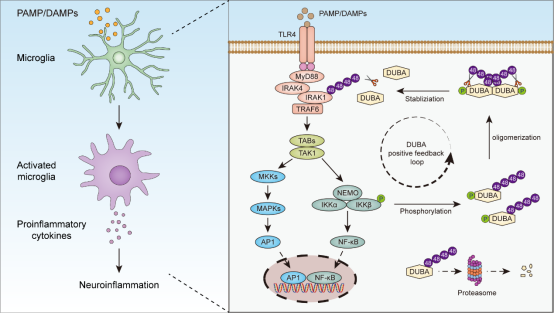
Mechanism Diagram of This Study
Manuscript URL:
https://advanced.onlinelibrary.wiley.com/doi/10.1002/advs.202503972