On May 21, 2025, a groundbreaking research paper titled “Islet transplantation in immunomodulatory nanoparticle-remodeled spleens” was published in Science Translational Medicine, a journal of the Science family. The study was led by Researcher Jian Xiao from Oujiang Laboratory in collaboration with Professor Dong Lei from Nanjing University, Professor Wang Chunming from the University of Macau, and Professor Huang Ling from Hainan Medical University. This study utilized nanomaterials to remodel the splenic microenvironment, transforming the spleen into an organ capable of sustaining islet survival and performing physiological islet functions.
Organ functional remodeling refers to the process of adaptive structural, functional, or metabolic changes in response to internal and external environmental shifts, representing a critical research direction in organ repair and replacement transplantation. In recent years, the Xiao Jian research group at Oujiang Laboratory/Wenzhou Medical University has overcome traditional clinical treatment bottlenecks in organ remodeling and regenerative medicine, as well as in growth factors and tissue repair. In their latest study, the team employed glucan-modified silica nanoparticles (KSiNPs) to remodel the highly vascularized spleen into an immunosuppressive microenvironment rich in extracellular matrix (ECM). This microenvironment provides a favorable “soil” for pancreatic islet grafts to survive. As a result, both syngeneic (mouse) and allogeneic (rat) pancreatic islet grafts rapidly completed vascularization within the KSiNP-modified mouse spleen and exhibited insulin secretion and hypoglycemic functions. In non-human primate (NHP) (NHPs)—crab-eating macaques—the team successfully transplanted human islets into the spleens of diabetic crab-eating macaques modified with KSiNPs, achieving effective cross-species islet implantation. Results demonstrated that human islets stably secreted insulin within the modified macaque spleens, effectively lowering blood glucose levels in diabetic macaques. This breakthrough not only expands donor sources but also provides a practical solution for clinical xenogeneic islet transplantation, offering new hope for diabetes treatment.
From wound repair to organ remodeling, Xiao Jian's research group leverages a multidisciplinary “growth factor+” approach to tackle clinical challenges. This study centers on spleen microenvironment remodeling, overcoming technical bottlenecks in traditional islet transplantation and offering a novel strategy with significant clinical translation potential. Featured on Science Translational Medicine homepage as “Featured Article”: “Immunologically Remodeled Spleen as a Transplant Site for Islets”
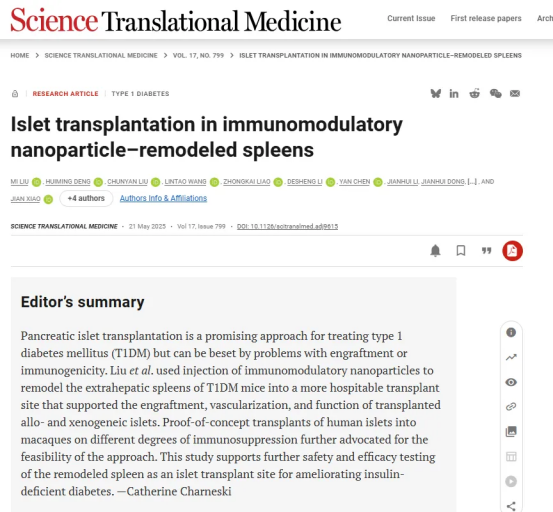
Editorial commentary accompanying the study: Islet transplantation holds promise for treating type 1 diabetes (T1DM), but may be hindered by implantation or immunogenicity issues. Liu et al. utilized injectable immunomodulatory nanoparticles to remodel the extrahepatic spleen of T1DM mice into a more suitable transplantation site, supporting the implantation, vascularization, and function of allogeneic and xenogeneic islets. Further validation by transplanting human islets into cynomolgus monkeys with varying degrees of immunosuppression demonstrated the approach's feasibility. This work supports further exploration of repurposing the spleen as an islet transplantation site to improve the safety and efficacy of treating insulin-deficient diabetes. — Catherine Chaneski
Manuscript URL:
https://www.science.org/doi/10.1126/scitranslmed.adj9615