In recent years, research has revealed that the onset and progression of Alzheimer's disease (AD) are closely associated with abnormalities in glucose and lipid metabolism. Evidence suggests that glucagon-like peptide-1 receptor agonists (GLP-1RAs), used to treat type 2 diabetes and obesity, not only improve peripheral glucose and lipid metabolism but also cross the blood-brain barrier to exert neuroprotective effects. This makes them a potential new strategy for preventing and treating AD, though their mechanisms of action and specific molecular pathways remain unclear.
On May 20, 2025, the research team led by Academician Weihong Song —a member of the Canadian Academy of Health Sciences, Director of the Oujiang Laboratory, and Dean of the Institute of Gerontology—and the team led by Researcher Yun Zhang from the Drum Tower Hospital Affiliated to Nanjing University Medical School published a study titled “Activation of AMPK by GLP-1R agonists mitigates Alzheimer-related phenotypes in transgenic mice” in Nature Aging. The study revealed that GLP-1R agonists significantly reduce core pathological features of AD and effectively improve cognitive impairment by activating AMPK, a key pathway in cellular energy metabolism. This breakthrough not only elucidates the critical molecular mechanism underlying the neuroprotective effects of GLP-1R agonists but also provides a new direction for developing metabolic regulation-based targeted therapeutic strategies for AD.
Glucagon-like peptide-1 (GLP-1) is a glucose-dependent incretin secreted by small intestinal L cells, playing a vital role in maintaining human blood glucose levels. GLP-1 promotes insulin synthesis and secretion while inhibiting glucagon release, thereby lowering blood glucose. GLP-1 also suppresses appetite and slows gastric emptying. GLP-1 receptor agonists (GLP-1RAs) are currently used to treat type 2 diabetes and obesity. Research suggests GLP-1RAs possess potential neuroprotective effects. However, whether GLP-1RAs can be utilized for the prevention and treatment of Alzheimer's disease remains an urgent question.
GLP-1 receptors exhibit widespread distribution within the central nervous system, including significant expression in cognition-related brain regions such as the hippocampus and prefrontal cortex. Nevertheless, the precise mechanisms by which they regulate cognitive function remain unclear. This study found significantly reduced peripheral blood GLP-1 levels in AD patients and model mice, with expression levels showing a significant negative correlation with PET-MR-detected brain Aβ plaque deposition (Figure 1). This discovery suggests that dysfunction of the GLP-1 signaling pathway may play a crucial role in the pathological progression of AD.
Researchers further enhanced the GLP-1 signaling pathway using the GLP-1 receptor agonists Exendin-4 (Exenatide) or Tirzepatide. They found that this enhanced pathway upregulates calmodulin kinase kinase 2 (CaMKK2), thereby activating the AMPK signaling pathway. As a key regulator of cellular energy metabolism, AMPK plays a central role in maintaining cellular energy homeostasis. Activated AMPK regulates Aβ metabolism through two pathways: 1) Inhibiting the NF-κB signaling pathway reduces transcriptional regulation of β-secretase (BACE1), thereby decreasing BACE1 enzyme production and its mediation of amyloid precursor protein (APP) cleavage and Aβ generation (Figure 2); 2) Significantly enhancing phagocytic function in microglia to promote Aβ clearance (Figure 3).
Concurrently, GLP-1RAs improve energy metabolism in astrocytes and neurons by elevating AMPK activity, thereby enhancing metabolic crosstalk between these cells. These multi-target effects ultimately reduce Aβ production and plaque deposition in AD model mice, effectively restoring cognitive function (Figure 4).
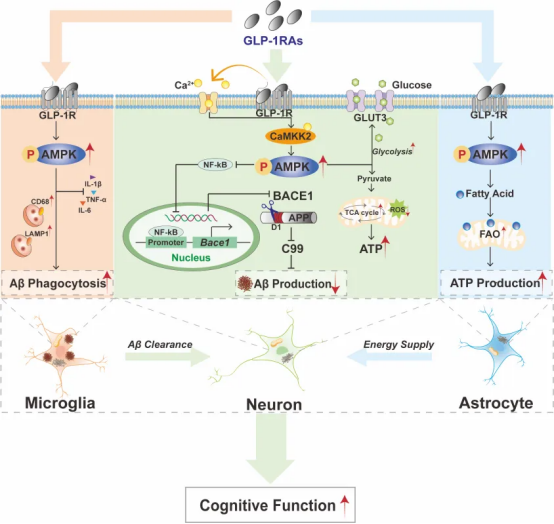
GLP-1 receptor agonists alleviate AD pathological features and cognitive impairment by regulating energy metabolism.
These breakthrough findings not only confirm at the molecular level the molecular targets through which GLP-1RAs improve neurodegenerative diseases by regulating glucose-lipid metabolism pathways, but also further establish a theoretical framework for the synergistic regulation of metabolic intervention and neuroprotection (Figure 5). The research results provide crucial experimental evidence for the clinical translation of GLP-1RAs in the prevention and treatment of Alzheimer's disease, which will significantly advance the development of related clinical trials and expand their indications.
Manuscript URL:
https://www.nature.com/articles/s43587-025-00869-3