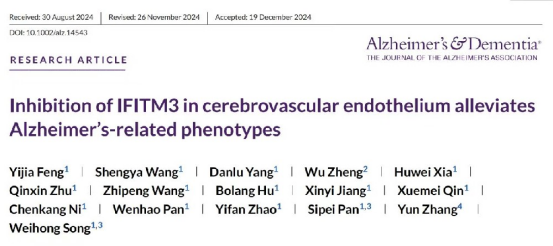
On January 14, 2025, the research team led by Academician Weihong Song—a Fellow of the Canadian Academy of Health Sciences, Director of Oujiang Laboratory published “Inhibition of IFITM3 in Cerebrovascular Endothelium Alleviates Alzheimer-Related Phenotypes” in Alzheimer’s & Dementia, a leading international journal on Alzheimer's disease (Five-Year Impact Factor: 16.5). Their study, titled “Inhibition of IFITM3 in cerebrovascular endothelium alleviates Alzheimer-related phenotypes,” identified a novel mechanism by which Interferon Induced Transmembrane Protein 3 (IFITM3) in cerebral vascular endothelial cells contributes to the pathogenesis of Alzheimer's Disease (AD). This research provides a novel therapeutic target for AD drug development and treatment.
The IFITM3 gene is located on human chromosome 11 at position 11p15.5, comprising two exons. Its coding region spans 611 base pairs, encoding 133 amino acids. Previous studies reported IFITM3 regulates γ-secretase. This research revealed abnormally elevated IFITM3 expression in the cerebral vasculature of AD patients and transgenic mice. By constructing a lentiviral vector to co-overexpress APP-Swedish and IFITM3 in human primary cerebral vascular endothelial cells, it was discovered that elevated IFITM3 in these cells increased the cleavage activity of BACE1 and γ-secretase, thereby leading to increased Aβ production. Treatment with a γ-secretase inhibitor significantly reversed the Aβ production increase caused by elevated IFITM3. Further studies revealed that Aβ oligomer stimulation of cerebrovascular endothelial cells significantly increased IFITM3 protein expression, creating a vicious cycle that exacerbates AD pathological progression. Specific knockdown of IFITM3 expression in cerebrovascular endothelial cells of AD transgenic mice markedly reduced Aβ pathological plaque deposition in both cerebral vessels and brain tissue, accompanied by significant cognitive improvement. This study elucidates the critical role of IFITM3 in cerebral vascular endothelial cells within the AD pathogenesis. It demonstrates that inhibiting IFITM3 expression in cerebral vasculature ameliorates Alzheimer's disease pathology and cognitive impairment, revealing the importance of restoring impaired cerebral vascular function for improving AD outcomes. This research identifies IFITM3 in cerebral vascular endothelial cells as a novel potential target for AD-specific therapeutic strategies.
Manuscript URL:
http://alz-journals.onlinelibrary.wiley.com/doi/full/10.1002/alz.14543