With the rapid advancement of artificial intelligence technology, AI applications in the healthcare industry are accelerating. Currently, the performance of AI algorithms relies heavily on being “fed” sufficient high-quality “data nutrients.” However, patient privacy protection and the scarcity of high-quality medical data have significantly constrained the widespread adoption of AI in healthcare.
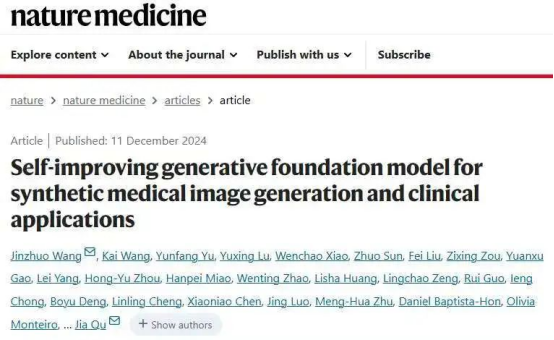
On December 11, the research team led by Jia Qu from Oujiang Laboratory, in collaboration with scientists from Wenzhou Medical University and Peking University's School of Future Technology, published a study titled “Self-improving generative foundation model for synthetic medical image generation and clinical applications” in Nature Medicine. This breakthrough introduces the world's first universal large-scale generative medical imaging model.
The research team introduced a unified medical image-text generation model named MINIM, capable of synthesizing medical images of various organs through different imaging modalities based on textual instructions. MINIM not only effectively addresses patient privacy concerns but also overcomes critical bottlenecks in training large medical models, such as the high cost of data annotation. MINIM is a cross-organ, multimodal generative medical imaging model. In ophthalmology, it demonstrates outstanding performance in diagnosis, evaluation, and research for complex clinical manifestations and challenging diseases, leveraging high-quality data.
Research findings indicate that MINIM-generated synthetic data achieves internationally leading levels in both physician subjective evaluations and multiple objective metrics. Its clinical utility has been validated in scenarios such as predicting epidermal growth factor receptor (EGFR) mutations and survival analysis in lung computed tomography (CT) images, and predicting human epidermal growth factor receptor 2 (HER2) mutation positivity in breast magnetic resonance imaging (MRI) scans. MINIM demonstrates outstanding generalization capabilities, extending its applicability to data generation across other organs and imaging modalities. It also incorporates a self-optimization mechanism, enabling the model to continuously enhance its generation capabilities based on physician ratings.
This research pioneers new directions for medical image data synthesis and application, providing robust technical support for advancing precision medicine and exploring personalized therapies.
Manuscript URL:
https://www.nature.com/articles/s41591-024-03359-y