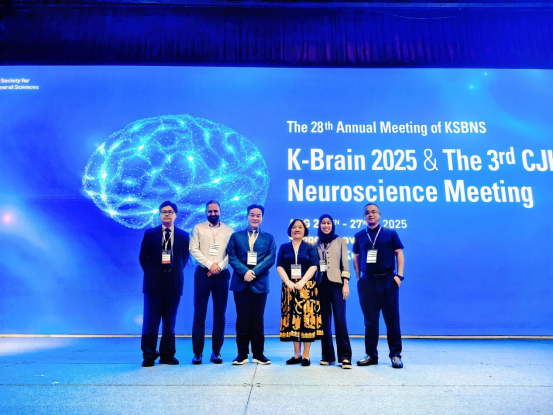
Recently, at the invitation of the Korean Society for Brain and Neural Sciences (KSBNS), Academician Liu Fang from the Oujiang Laboratory traveled to Incheon, South Korea, to attend the 28th Annual Meeting of KSBNS K-Brain 2025 and the 3rd CJK Neuroscience Meeting. This event stands as one of the most significant annual gatherings in neuroscience in Korea and globally, both in scale and influence. Centered on the theme “Frontiers in Neuroscience and Transnational Collaborative Innovation,” the conference focused on multiple cutting-edge fields including fundamental neuroscience, translational medicine, cognitive neuroscience, and glial cell research. It brought together numerous leading experts and scholars worldwide to collectively explore the latest advancements and collaborative opportunities in brain science and neurology.
From Basic Research to Clinical Applications: Oujiang Laboratory Advances Translational Research
At the conference, Academician Liu Fang delivered a keynote presentation titled “Therapeutic Effects of Small Molecules Targeting AMPA-Mediated Excitotoxicity in Multiple Sclerosis,” systematically outlining her team's latest advancements in AI-assisted drug discovery. This research innovatively proposes a novel therapeutic strategy for multiple sclerosis (MS). By precisely targeting disease-specific protein complexes (rather than completely blocking receptors), it aims to achieve more efficient and less toxic therapeutic effects, offering new insights for related drug development. The team discovered that abnormal coupling between the AMPA receptor subunit GluA2 and GAPDH protein may correlate with neural damage in MS, thereby identifying a novel therapeutic target. Using a convolutional neural network-based AI algorithm, they screened 520,000 molecules to identify the lead compound ZCAN262. In animal models, this compound has demonstrated positive effects including improved neural function and enhanced myelin regeneration. This research not only uncovers novel therapeutic targets for MS but also achieves preclinical breakthroughs through AI-enhanced drug screening, fully demonstrating Oujiang Laboratory's outstanding capabilities in translational research.
Strengthening International Collaboration to Enhance Scientific Influence
During the conference, Academician Liu Fang engaged in in-depth discussions with internationally renowned scholars including Professor Lisa M. Monteggia from Vanderbilt Institute for Brain Research and Professor Peter Walter from Altos Laboratories. These exchanges further elevated Oujiang Laboratory's visibility and influence within the global neuroscience community. The research findings not only pioneer novel therapeutic approaches for multiple sclerosis but also showcase Zhejiang Province and Wenzhou City's robust scientific research and innovation in the life sciences and health sector. Moving forward, Oujiang Laboratory will continue to focus on national and regional development needs, contributing to the advancement of brain health.