Recently, Professor Moosa Mohammadi from Oujiang Laboratory was invited by Professors Sabine Werner and David Ornitz to attend the joint conferences “Growth Factors in Lung Development, Repair, and Regeneration” and “The 3rd Conference on Niche-Epithelial Stem Cell Interactions in Lung Health and Disease,” hosted by the Fusion Conference in the Dominican Republic. The conference focused on breakthrough research in regenerative growth factors (such as FGFs and VEGF) across fields including tissue repair and stem cell therapy.
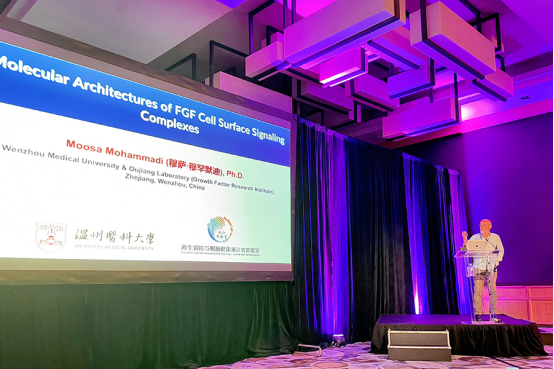
During the conference, Professor Moosa Mohammadi delivered a 30-minute invited lecture titled “Molecular Architecture of FGF Signaling Complexes.” He presented unpublished findings from his team at the Oujiang Laboratory Cryo-EM Center, revealing the structures of complexes formed by various paracrine FGFs with their corresponding FGF receptors (FGFRs) and heparan sulfate (HS) co-receptors. Based on these structural data, Professor Moosa confirmed for the first time that paracrine FGFs can transmit signals through asymmetric FGFR dimerization. A paper detailing this breakthrough discovery is currently being prepared for submission to Nature.
During the conference, Professor Moosa engaged in in-depth discussions on FGF signaling mechanisms with leading scholars including Professor Laurence Legeai-Mallet from the Imagine Institute in Paris, France, and Professor David Ornitz from the University of Washington. Preliminary agreements for future collaborations were reached. Additionally, the advanced research facilities at the Oujiang Laboratory Cryo-EM Center became a focal point for attending experts. Professor Maximina Yun from TU Dresden and other specialists highly praised these facilities, recognizing them as landmark infrastructure for conducting cutting-edge structural biology research.